Prosus has reduced its shareholding in Tencent to 23.995%. The proceeds from the open market disposal of 474,000 ordinary shares will be used to fund the company’s continued implementation of its repurchase programme.
Following the results of the scrip dividend elections, Oasis Crescent Property will issue 529,634 new units in the company in lieu of a final cash dividend, resulting in the reinvestment of R15,73 million. Datatec will issue 2,965,247 new ordinary shares resulting in a capitalisation of distributable retained profits in the company of R116,32 million.
Pan African Resources will issue 112,812,217 new shares as payment for the US$54,2 million (R943 million) acquisition of Tennant Consolidated Mining Group in early November 2024.
The JSE welcomed the secondary listing of Supermarket Income REIT on 13 December 2024. The UK-based, LSE-listed real estate investment trust is an investor in omnichannel supermarket properties across the UK and France. The secondary listing, by way of the fast-track listing process, saw 1,246,239,185 shares list on the Main Board in the Retail REITs sector.
The JSE has approved the transfer of the listing of Sygnia to the General Segment of Main Board with effect from commencement of trade on 10 December 2024. Marshall Monteagle and Ayo Technology Solutions followed suit on 11 December and Combined Motor Holdings on 13 December 2024. The listing requirements in this segment are less onerous for the smaller cap firms.
Following the implementation of the acquisition by NewRiver REIT of the shares of Capital & Regional (C&R), the C&R shares, listed on the LSE and JSE, were suspended and will delist from the JSE on 27 December 2024.
The Board of Dipula Income Fund will ask shareholders at the next AGM in February 2025 to approve a change of name to Dipula Properties which, the Board believes, more accurately reflects the nature of the company’s business. If approved, the name change will be effective 12 March 2025.
This week the following companies repurchased shares:
Hammerson plc continued with its programme to purchase its ordinary shares up to a maximum consideration of £140 million. The sole purpose of the buyback programme is to reduce the company’s share capital. This week the company repurchased 440,841 shares at an average price per share of 290 pence.
In line with its share buyback programme announced in March, British American Tobacco this week repurchased a further 358,290 shares at an average price of £29.72 per share for an aggregate £10,65 million.
During the period 2 – 6, December 2024, Prosus repurchased a further 3,192,838 Prosus shares for an aggregate €126,4 million and Naspers, a further 233,242 Naspers shares for a total consideration of R1 billion.
One company issued a profit warning this week: Transaction Capital.
During the week, five companies issued cautionary notices: Europa Metals, Astoria Investments, Barloworld, Murray & Roberts and Transaction Capital.
Pan-African infrastructure investor and asset manager, Africa50, has invested US$15 million in Egypt’s Raya Data Center to acquire a 42.9% stake. The funding will be used to establish a new Tier III data centre in Egypt. Raya IT will be investing an additional $10 million into the project and plans to raise an further $10 million required to complete the project from financing institutions.
Aradel Holdings Plc, the NGX-listed integrated energy company, has acquired a 5.14% equity stake in Chappal Energies Mauritius. Financial terms were not disclosed. Chappal Energies signed a SPA in July 2024 with Total Energies to acquire a 10% stake in the SPDC JV in Nigeria and at the end of November, announced that it had acquired Equinor Nigeria Energy Company which holds a 53.85% stake in Nigerian oil and gas lease OML 128.
JSE-listed Bidvest Group has announced the sale of its entire banking business to Nigeria’s Access Bank for ZAR2,8 billion (c.US$158 million). Access Bank entered the South African banking market in 2020 through the acquisition of a controlling stake in Grobank. The banking group operates in 24 countries around the world including 16 in Africa.
Nigeria’s Biilboxx, a fintech specialising in invoicing and cash flow management for SME’s, announced that it had raised US$1,6 million in pre-seed funding. Norrsken Accelerator, Kaleo Ventures, 54 Collective, P2Vest and Afrinovation Ventures participated in the combined debt and equity raise.
Senegalese healthtech, Eyone Medical, has closed a US$1 million fundraise from Sonatel ($855,000) and BICIS Groupe ($145,000).
British International Investment platform, Growth Investment Partners Ghana has made undisclosed investment in Ghana’s Rikair Company. Rikair is a local provider of medical oxygen, equipment and infrastructure.
Incofin Investment Managers and its Nutritious Foods Financing Facility partners, the Global Alliance for Improved Nutrition (GAIN), USAID and the Swiss Agency for Development and Cooperation, have announced a total investment of US$1,55 million in East Africa’s Truk Rwanda and Senegal’s Couvoir Amar, to enhance food security and nutrition in sub-Saharan Africa. Truk Rwanda is a logistics company providing cold chain storage and transport for fresh fruit and vegetables. Couvoir Amar operates within the Senegalese poultry industry.
Taranis Investment, the investment division of the Perenco Group, announced the acquisition of the Africa business of Akuo, an international developer and producer of renewable energy. The deal includes the 50 MW Kita, the largest solar farm in Mali, commissioned by Akuo in 2020.
There are various ways in which an acquirer can purchase a stake in a target company. The most common method is the payment of a cash amount by the acquirer to the seller, in exchange for the seller’s shares. Other methods include asset-for-share and share-for-share transactions.
In a share-for-share transaction, the acquirer acquires the seller’s shares and, in exchange, the seller receives shares in the acquirer. Share-for-share transactions offer various benefits to sellers and acquirers, including:
potential upside for the seller if the acquirer’s share value appreciates;
tax efficiencies (Section 42 of the Income Tax Act makes provision for these transactions to be tax neutral);
preservation of cash and debt capacity; and
lower transaction costs.
Like any M&A deal, share-for-share transactions are not without risk. In recent years, there have been several high-profile deals which either collapsed or the sellers suffered significant losses.
In 2016, retail giant Steinhoff acquired footwear retailer, Tekkie Town.1 In exchange for 58% of the shares in Tekkie Town, the founding shareholder received Steinhoff shares worth R1,85 bn. A year after the deal was concluded, Steinhoff imploded after its auditors discovered that it had been overstating its profits for over a decade. Following the revelation, Steinhoff’s share price plummeted by more than 95%. Without oversimplifying, the impact was that each R1 worth of shares that the seller had received in the Tekkie Town deal was suddenly worth five cents.
This transaction highlights the risks that sellers are faced with in share-for-share transactions. Sellers need to be aware of the risks and take steps to protect themselves. Some of the ways to mitigate downside risk include due diligence, earn-out arrangements, warranties and indemnities, price adjustment mechanisms and escrow arrangements.
Due diligence
Before accepting shares in the acquirer as consideration, the seller must take steps to establish that it is receiving shares in a financially sound entity. It is vital for the seller to conduct some form of due diligence on the acquirer to get insights into the latter’s affairs, on which the value of the acquirer’s shares is premised.
Due diligence should focus on, among others, the financial statements, tax and legal affairs, governance, reputational issues, and any other factors that impact the value of the acquirer’s shares.
Warranties and indemnities
Obtaining warranties and indemnities from the acquirer is another way for a seller to mitigate risk.
A warranty is a contractual assurance by one party – in this case, the acquirer – to another as to the true state of the affairs of the acquirer. If a warranty later turns out to be false, then the seller may have a claim against the acquirer. An indemnity is a promise by one party to hold the other party harmless in the event that a loss arises from a specific event.
To mitigate its risk, a seller may seek warranties and indemnities in respect of, among others, the accuracy and truthfulness of the acquirer’s financial statements, tax compliance, and losses resulting from the conduct of the seller or its directors.
Shareholders in the 2014 Alviva deal saw a significant decline in the value of the shares they had received in the acquirer, when a director of the acquirer was implicated in a bribery case after the conclusion of the transaction.2 Well drafted warranties and indemnities in respect of acquirer conduct can mitigate the seller’s risk in such cases.
Earn-outs
The seller may negotiate an earn-out arrangement, in terms of which it will only accept a portion of the acquirer’s shares upfront, and only accept the remainder if the acquirer meets certain performance targets. Such a target may be a revenue target, or that the acquirer’s share price reaches a particular value after a certain period (the earn-out period). An earn-out may be structured in a way that ensures that the seller is entitled to an agreed cash amount instead, or a return of some of its shares if the acquirer fails to meet the performance targets.
Price adjustment mechanisms
Price adjustment mechanisms may be applied if certain events occur during the negotiation of the deal or once it is concluded. An example of an adjustment mechanism the seller may use to mitigate against downside risk is a material adverse change provision, in terms of which the purchase price is adjusted downward if the value of the acquirer’s shares falls below a certain threshold before the deal is finalised. Alternatively, the seller may be entitled to an additional cash amount if the acquirer’s share value decreases within a certain period after the conclusion of the deal.
Escrow arrangements
An escrow arrangement, where the seller’s shares are held in trust for an agreed period, may also be used to protect the seller against breaches of the acquirer’s warranties and indemnities. Depending on the terms agreed between the parties, the seller may be entitled to a return of the shares held in escrow in the event of a breach by the acquirer.
While share-for-share transactions offer various benefits in M&A deals, it is clear that they should be approached with the necessary level of caution. A share-for-share deal presents the seller with comparatively more risk than a share sale where a seller receives a cash amount. In light of this, it is crucial that sellers take the necessary steps to mitigate their risk before accepting the acquirer’s shares as consideration.
1. Steinhoff International Holdings N.V v Tekkie Town (Pty) Ltd [2016] ZACT 103. 2. The bribery charges against the acquirer’s director were subsequently withdrawn.
David Hoffe is a Partner and Tuelo Mokoka and Siyabonga Nyezi are Associates | Fasken.
This article first appeared in DealMakers, SA’s quarterly M&A publication.
In the complex landscape of African mining, particularly in South Africa, the concept of sustainable development has long been a point of contention. Mining companies, faced with increasing pressure to contribute to long-term community development, often view these initiatives as an additional tax – a perspective that can hinder both mining operations and genuine sustainable growth.
A paradigm shift is needed: from viewing mining companies as direct providers of development to seeing them as catalysts for sustainable economic ecosystems.
THE CURRENT PARADIGM: Unsustainable and unappreciated
The traditional approach to sustainable development in mining regions has been characterised by the direct provision of services and infrastructure by mining companies. This model, while well-intentioned, presents several critical issues, such as:
Increased operational costs: Mining companies often see sustainable development initiatives as an additional financial burden, potentially driving away investment and increasing cut-off grades, thereby sterilising minerals that could otherwise be economically extracted.
Misaligned responsibilities: Local municipalities, facing their challenges, increasingly push their responsibilities onto mines. This blurs the lines between corporate social responsibility and governmental duty.
Lack of recognition: Despite significant investments in schools, clinics and other infrastructure, mining companies receive little recognition. Host communities often view these provisions as rights, rather than corporate contributions.
Post-closure unsustainability: Services and infrastructure provided directly by mines often become unsustainable after mine closure, leaving communities vulnerable.
Siloed approaches: Different departments often pursue separate sustainability initiatives within mining companies, missing opportunities for synergy and efficiency.
THE CATALYST MODEL: A new approach to sustainable development
To address these challenges, we propose a shift towards a “catalyst model” of sustainable development. In this approach, mining companies focus on creating conditions that catalyse broader economic development and attract diverse investments. Key elements of this model include:
Strategic infrastructure development: Instead of building infrastructure solely for mining operations, companies should design and develop infrastructure that can serve as a foundation for diverse economic activities post-mining.
Land use planning for the future: Mining companies should engage in long-term land use planning, considering how mining lands can be repurposed for agriculture, tourism or other industries after mine closure.
Skills development for diversification: Training programmes should focus not just on mining-related skills, but on transferable skills that can support a diversified local economy.
Incubation of local businesses: Mining companies can act as incubators for local businesses that can serve the mine but are not wholly dependent on it, fostering a more resilient local economy.
Collaborative governance models: Developing structures for collaborative decision-making between mining companies, local governments and communities can ensure more sustainable and widely accepted development initiatives.
Benefits and key considerations of a catalyst approach
Embracing this catalyst model offers several benefits, such as reducing the perceived extra operational costs, which can make mining investments more appealing. Concentrating on initiatives with multiplier effects ensures more efficient resource utilisation, which fosters the development of a diversified local economy that can prosper beyond the mine’s lifespan. By acting as catalysts, rather than service providers, mining companies can contribute to clearer stakeholder roles and responsibilities, potentially enhancing overall governance and service delivery. A successful catalyst approach can substantially improve community relations and strengthen the social license to operate.
Transitioning to a new catalyst model will necessitate significant adjustments from all parties involved. Governments must establish policies that encourage and reward this model, possibly through tax incentives or licensing regulations. Mining companies should adopt a more cohesive approach, breaking down departmental barriers to fully leverage the catalytic potential of their operations. Transparent communication with communities and other stakeholders is essential to manage expectations and emphasise the long-term advantages of this strategy.
New metrics will be required to gauge the effectiveness of sustainable development initiatives, focusing on long-term economic resilience, rather than short-term service provision. Furthermore, mining companies should collaborate on regional development initiatives, combining resources and expertise for a more substantial impact.
A call for transformative action
The catalyst model represents a transformative approach to sustainable development in mining regions. By shifting from direct provision to strategic enablement, mining companies can contribute to truly sustainable development while potentially reducing costs and increasing investment attractiveness.
Adopting this approach demands a long-term vision, creative problem-solving, and a collective effort from all parties involved. While challenging, the benefits of this transformation – thriving local economies, strengthened community ties, and a more environmentally conscious mining sector – make it an essential and worthwhile pursuit.
As we navigate the complex challenges of sustainable development in African mining, the catalyst model offers a promising path forward. It’s time for mining companies, governments, communities and investors to embrace this new paradigm and work together towards a more sustainable and prosperous future for mining regions across the continent.
Bruce Dickinson is a Partner | Webber Wentzel
This article first appeared in DealMakers AFRICA, the continent’s quarterly M&A publication.
In this final episode of The Trader’s Handbook, Shaun Murison joined me to wrap up an insightful season by exploring the cornerstone of trading success: crafting a solid trading plan.
From setting realistic goals and managing risks to refining strategies and maintaining discipline, we covered the essentials that help traders stay on course in a chaotic market.
Whether you’re just starting or looking to fine-tune your approach, this episode provides actionable advice and reflections from a season packed with trading wisdom. Don’t miss this culmination of key lessons and practical tips designed to elevate your trading game.
Whether you’re new to trading or looking to refine your approach, this episode provides practical insights into leveraging technology to stay ahead in the markets. To open a demo account, visit this link.
Listen to the episode below and enjoy the full transcript for reference purposes:
Transcript
The Finance Ghost: Welcome to this episode of The Trader’s Handbook. We’ve made it – this is the very last one. You’ve also made it if you’ve joined us throughout the season. Thank you so much for that. If you are only listening to this as the first one, then kudos to you. I always have respect for anyone who starts backwards. Maybe go and listen to some of the other stuff as well because there’s some pretty good stuff in there.
This is episode 13 and it’s the last one of The Trader’s Handbook. We’ve covered a lot. With Shaun Murison from IG Markets South Africa, we’ve covered everything from the absolute basics of trading – what does it mean to be long? What does it mean to be short? We’ve dealt with the impact of leverage and how CFDs actually work. We’ve done key risk management strategies like stop losses and all the different types that you can use.
We’ve talked about some of the trades that I tried throughout the season with varying levels of success, as you would expect in the market. Some worked out pretty well, others did not at all. And I’ve learned some really good lessons along the way through that process and it really just proves how important it is to open a demo account, something that we’ve talked about a lot on this podcast season.
You can go and open up a demo account with IG. You can go and try this stuff out before you put real money in. Rather go and make the mistakes with the play-play money and learn from that.
We’ve also talked about trading indicators and we’ve talked about technical analysis tools. We’ve talked about the IG Markets Academy, which I’ve got to say really is a great source of information in that regard and I would highly recommend that budding traders go and check it out – and also just anyone really, because there’s always something to learn. No one knows everything and I think the Academy is a wealth of information. It’s free to read. Go and check it out. There’s so much in there.
We’ve discussed different asset classes as well. We’ve discussed the different instruments you can trade. We had a show on index trading. We had one on forex. We had a very popular one on commodities. It seems like people definitely want to be out there trading gold and oil. Maybe it’s just a reflection of where the gold price has been this year? It’s been a very strong year for gold, but still. That was particularly interesting for me given my background in single stocks. I came into this podcast series understanding single stocks investing, I like to think reasonably well. I have very much an equities background. Trading single stocks is something completely different. I think when you start to see what the benefits are of trading stuff like an index or forex or commodities, that really comes through.
In the last show, we talked about the tech of trading, so concepts like scanning for opportunities and doing back testing and all of the stuff you can do on the IG Markets platform.
It has been a pretty great season. It’s quite fun to look back on all the shows and realise just how much we’ve covered. To bring it home and to bring the season to a close, we are doing a podcast on trading plans now. I think we’ve made it pretty clear on this podcast season throughout the podcasts, actually, that trading is very exciting, yes, but it is also complicated. If you think it’s easy and you follow people on Instagram with their fancy cars that they stood in front of for a millisecond to take a photo in front of – someone else’s car – to show you how easy trading is and how much money they make, that’s not how it works in the real world. Yes, you can make a lot of money trading, but it is difficult and I think the trading plans really help to just maintain your sanity and tie it all together. So that is where we will be finishing off as we tie this whole season together.
Shaun, that was a long intro, but I wanted to give people a flavour of what else they can go and find in case for some reason they’ve joined us here for the first time. Thank you for doing this with me. The last one, Shaun, you’ve made it!
Shaun Murison: We made it. It’s always a pleasure, though. I’ve enjoyed the season very much.
The Finance Ghost: No, it’s been great, I must say. Let’s dive into trading plans and I think let’s just start with the basics, right? In the simplest terms possible, what is a trading plan?
Shaun Murison: Okay, so a trading plan, very simply, is like a business plan, especially if you view trading as a business. How are you going to go about your business? How are you going to manage your risk? How are you going to manage your expenses? Your income? How are you going to allocate time? It’s really just creating an all-encompassing system around how you’re going to approach getting involved in the markets, trading the markets, and how you’re going to improve as you go along, growing that business.
The Finance Ghost: I think previously in the season when we actually talked about how you manage trading losses and your mindset around that, you made that analogy that trading is a little bit like running a business. So rather than beating yourself up about, oh, I lost money like this, why am I here? It’s more like, okay, these are the expenses, and as long as I’m coming out with a profit, I’m kind of doing okay.
I think the business plan analogy ties in quite well with that actually. And this is important stuff. Look, I’m not a great poster child for business plans. I never actually did one for The Finance Ghost on paper, but I certainly had one in my head. I think a lot of people do that. You’ve got to have a plan, you’ve got to have a strategy, otherwise what are you doing? You’re just going to wake up every day and just see what you feel like that day. That’s not going to end well for you or anyone around you, so this is important stuff.
I think with trading, it’s even worse because there’s just so much noise out there every week, right? You get absolutely bombarded with news and headlines and data that you can trade. There are a gazillion instruments out there. You can randomly wake up one Tuesday and say, oh, today I feel like trading forex and the next day you’re trading equities. You can really hurt yourself. I think it’s much worse in some respects than a business. You can’t wake up in your business one day and say, hey, today I’m a restaurant and tomorrow I’m a hardware store and next week I’m a dry cleaner. I don’t know, those were the silly examples that came to mind! But in trading you can do that stuff and that’s very, very dangerous. So how do trading plans help you with this? How do they bring discipline?
Shaun Murison: Yeah, I think a lot of people, when they talk about trading and a trading plan, the focus is always on when to buy and when to sell. But it’s a lot more to that. It’s how much money are you going to risk when you’re wrong? How are you going to formulate your strategies? How much time do you have to allocate to the markets? How are you going to learn from your mistakes? You talk about markets being chaotic and it can be quite overwhelming. That’s why we always push the idea of trading in a risk-free environment. Start off with that demo account, go make the mistakes and see where your skill set lies or what instruments might be better for you to trade, and that can start forming part of your plan. A demo account actually could be part of a trading plan, the sort of initial stages of practising, getting your business ready before you actually go to market.
The Finance Ghost: Yeah, so it’s not to say that a trading plan is, hey, I’ve looked at these five charts and these are the exact five companies that I’m going to trade this week, or these are the five setups. That might be part of a trading plan and we’ll get into the components just now. But I think the point is that it’s way more high level than that and it’s kind of this overarching – just to use your business plan example, those, oh, I’m going to do these five companies this week or these five indices or whatever else – that can be something like, oh, I’m going to sell to these five customers. But that’s not your business plan. That’s this week’s tactic. That’s not the same thing. That’s your immediate thing you’re going to focus on. That’s not the same as your business plan.
I think we’ll make this clearer by going into some of the key components of a trading plan. Maybe you can just cover those components off and just comment on whether or not this is something you’re doing weekly, daily, monthly – how often are you really updating these different components?
Shaun Murison: Look, I think starting off with the key components, for me you obviously have got to have a goal and ambition. You have to recognise time and strategy, the time you have to allocate to markets that might determine the type of strategy that you would use. How much money you’re going to risk within that market on any one trade or of your portfolio at once. And then in terms of how often you could plan, I think you have to look to continually improve your plan. You need to diarise what you’re doing. You’ll have an initial plan and you’ll diarise what you’re doing and then you’ll do some self-assessment and work towards continuous improvement.
The Finance Ghost: Yeah, that makes sense. And then in terms of how often you’re actually updating this thing…
Shaun Murison: No, it’s continuous. I think that’s where the self-assessment of it comes into play. If you have a diary, you can write down the things like how you felt when you placed a trade, see how you reacted emotionally, did it inhibit your decision making? If now your plan says, oh well, I struggle to get out of a trade that moved against me, I struggled to implement a stop loss, then you realise that’s a weakness and something that you could be improving within your trading plan. And how would you improve that? Well, if that’s a weakness of yours, automate that. Use stop losses in the system so that you don’t have to think about getting out of a trade or second guessing yourself if it’s moving against you. You’ve already made that decision. The important part about trading is making all the decisions for the trade before you get into the trade. Because once you’re inside of a trade and you’re looking at your bank balance either going up or down, what you’re going to see is that emotion is going to be a factor. We can remove that emotion with something like a stop loss or an automated system and utilise that. But that might not be where you start, that might just be an example of improving your plan.
It’s all about continuous improvement. You create your initial plan. You work to your plan, assess your plan, see where it’s, where it’s working, where it’s failing and then review. And so that could be on a weekly or a monthly basis, which all depends on how active you are in the market.
The Finance Ghost: Yeah, it’s a very iterative thing and I think that’s exactly how a business works as well, so that analogy just keeps working so well. You might have this plan, but you’ve got to then adapt the plan to what’s going on out there. You’ve got to update it based on what’s happening. You’ve got to remember good old, I think it was Mike Tyson who said “everyone has a plan until they get punched in the face” – I think the market will probably punch you in the face a few times. But I think you still need to have your trading plan. I think his view is actually extremely applicable to running a business because there you have to react quickly. You can’t just sit there and say, oh, you know, I’m going to carry on with this business plan even when it’s clearly not working. You’ve got to adapt quickly.
I guess with a trading plan, trades are going to go against you even when you didn’t do anything wrong because you just got unlucky. That’s the nature of the markets, I guess. You’ve got to be careful not to say, oh, my trading plan is terrible because I had an unfortunate trade, right? It’s gonna happen. It’s part of the game.
Shaun Murison: Yeah. I think without going through all the cliches, but failing to plan is planning to fail. If you’ve got a strategy and you’ve got a trading plan and you’re getting involved in the market, two things can happen. One is you’re making money, or two, you’re losing money. If you’re losing money, why are you losing money? Are you losing money because your plan is failing? Or are you losing money because you’re not following your plan strictly? But you don’t know that unless you’ve actually documented what you want to do and how you want to go about this business of trading and actually just measured your success and measured those failures and look to tweak that plan as you go forward.
The Finance Ghost: I think let’s look at some of these components in a little bit more detail. The first one you raised was this concept of goals and ambitions. All sounds lovely. The ambition, surely, is just to make money? No, I’m kidding. I think it’s a little bit more nuanced than that. What would these goals be? Would they typically be financially based? I want to make R1,000 this week, I want to make R10,000 this week. Or is it other stuff like I want to try out a specific strategy this week?
Shaun Murison: Well, I mean, it’s different for each person, but it just needs to be clearly defined. The overarching factor is we are all in the business to try and make some money, aren’t we? So your goal is to make a profit, but what is a feasible return? Can you make 20% a year or 100% a year? What is a feasible return and what can you achieve?
I think monetary could be one of the goals. The other goal might be to be disciplined in your approach to trading, being able to execute your strategy. It’s multi-faceted. But as in life, you’ve got to have goals and got to have targets. You know, you can see whether you can achieve those targets or not.
The Finance Ghost: Yep, that makes perfect sense. Of course, you’ve got to be realistic in terms of how much time you actually have to achieve these goals. If you’re working a full-time job and you have two kids and everything else, you’re not going to be doing a huge amount of day trading, I don’t think, or if you are, you are going to just have a bad outcome from all of this. So how do you find a way to make it all work? Is that part of your trading plan? Would you basically say, look, this is how many hours I have a week and this is when I’m going to trade? Or something we’ve talked about on previous shows which is just set the trades up and let them run in the background and put in place your stop losses and keep an eye on them? We actually have talked about some of that stuff of how to fit trading into your lifestyle.
Shaun Murison: Yeah, I think that’s a very important component in terms of how much time you have to allocate to the market. It’s funny when you start looking at the people that are trading very short-term. We talk about the day trading, the scalping and that type of stuff that generally requires a lot more time. I know most of the people listening to the podcast have day jobs and so they don’t have all day to sit and watch markets. That time allocation, when do you have time to look at markets and which markets are open when you have time to trade?
If you’re busy during the day, maybe something like a trend following approach or swing trading approach might be more appropriate. Where you’re holding a position for a couple of days to a couple of weeks, that’s really just assessing your surroundings and what you can allocate to the market. For example we mentioned the US indices, we recently introduced a rand-based account with IG. So if you were trading, you don’t have time to trade the South Africa 40 index or if you’re an index trader during the course of the day and maybe you have some time in the evening, maybe that’s the type of market that you’d be trading. Maybe you’re looking at a 24-hour market like a forex market, that might be more suitable to you. Or if you have a little bit less time, you’re doing a little bit of analysis in the evenings, you want to set your orders in there, into the market and let it trade for you. Hold your positions for a couple of days to a couple of weeks. You might be more suited to trading shares and equities in a derivative format.
It really is just knowing your own limitations in terms of time when you can actually trade and that will just dictate the frequency with which you are trading within the market.
The Finance Ghost: Yeah, it really comes down to just playing to your strengths, right? It’s that business plan point again. What can you realistically do? It doesn’t help to set yourself an unrealistic plan. Pick markets you can trade that suit your lifestyle, suit your abilities, suit the amount of research you can or can’t do. It really does make a lot of sense.
And of course the other thing you have to think about is how you will manage your risk. This is something that we’ve just kept on driving home this whole podcast season, is how important risk is. And it’s not just whether or not we use stop losses, right? It’s also the maximum that you might be willing to risk per position. Overall, I imagine it’s very easy to get drawn into a situation where, I don’t want to use the word gambling lightly, but I think that if you don’t have self-control in the world of trading, it can very quickly go down that road to say you just keep throwing money at it. Oh, I know that was a bad outcome, but you know, the next one’s going to work! Or you get greedy and you think, well, I’m on a purple patch here, I’ve had a really great few days, let me now dig into the savings account.
You’ve got to be super disciplined with this stuff, right?
Shaun Murison: Yes. Risk management is key. I think it’s probably the most important thing. High risk, high reward, that is the environment. The first part of your game is a defensive one. General guidelines on the short-term trading there – don’t risk more than 1% of your portfolio in any one trade, maybe up to a maximum of 5% if you are a bit more risk tolerant.
In terms of managing your risk, there are other risks to the market and we do find, especially new traders, they tend to – you know, there’s emotion. We’ve always talked about the emotion and that’s something that you obviously need to be aware of. You can’t stop emotion, but be aware of. Common mistakes when we’re talking about risk, we find that traders might have a win or two and then get a bit overexcited and over-trade. They trade too frequently through that euphoria. And also trading too big, taking position sizes that are too big relative to the money in the account. Those are two of the most common mistakes that we see traders make.
In terms of managing risk, there needs to be a bit of a discipline there. It needs to be a self-awareness of your emotions, of are you trading through euphoria? Are you trading through depression? There’s a friend of mine who always used to say he had one rule about trading, he says, and he put it in his trading plan: don’t trade when you’re sick. He said when he’s not feeling well, he doesn’t think. His ability for rational thinking isn’t there.
To each their own. But managing risk is the most important part of trading, in my opinion.
The Finance Ghost: Yeah, it certainly makes sense. And you’ve got to figure out what works for you. That’s the point of a trading plan. It’s specific to you. There’s no one-size-fits-all where you need to then follow someone else’s plan. That’s not going to work. This also talks directly to routines. Your routine is going to be very specific to you and it’s something that you raised as well when we were thinking about doing the show. This concept of a trading diary sounds very old school, it’s kind of a nightly “Dear Diary” moment with pen in hand, writing about your trading day. Would you say that most trading plans genuinely are that kind of handwritten notepad next to your computer while you’re trading? Does that drive better discipline? Or do you find that people type it? It’s obviously specific to people and their preferences again, but I’m just curious what your experiences have been and what you find most traders have done.
Shaun Murison: I think you’ll end up with a whole loads of different spreadsheets. If you’re trying different types of strategies, you might have these Excel spreadsheets just tracking your progress and your reports and obviously there’s a lot of reporting from your trading account that you can get as well. But I think keeping a diary is a very, very important tool and the discipline to keep following it. I’m not always the most disciplined with it, but I try to be. I find that my ability to improve my own work is much better if I can actually just track what I do, just simple things like, why did you get into the trade? Why did you exit the trade? Were your assumptions correct? Did you use a stop loss? Did that stop loss hinder the trade? Did it keep you out of trouble or was it too close, maybe if you had a different level stop loss?
But the point is that the trading diary just helps with understanding what you’re doing and you can reflect and just see where you’ve gone wrong and gone right. At the end of the day, you need to see if your plan is working or not. A diary is going to really help you with that. It’s going to help you identify the strengths and weaknesses of that plan.
I suppose it’s like “buy the rumour, sell the fact” – this is what we think is going to happen in markets and this is how we’re going to be trading. And when we actually start to implement the strategy or this plan, this is what really happens. So continual self-assessment. Continual improvement and self-improvement.
The Finance Ghost: That almost answers the next question, which is how often should you really be doing the self-assessment? And like you say, it’s pretty much continuous. It’s striving for an iterative process where you are checking in on what you thought was going to happen. Here’s how it played out.
I think just being honest with yourself – it’s like when you go and play golf, you can always just cheat very easily. But what’s the point? It’s your score at the end of the day, and if you are getting better by cheating, then you’re only cheating yourself. What are you even doing? So rather go through the hard yards, go through the process. If you waiver from your trading plan, then you’ve got to make a note of that and you’ve got to be honest with yourself and really think deeply about this stuff because it can really swallow you up. I think the world of trading can be incredibly exciting, but it is something that you need to treat with immense respect. I think a trading plan goes a long way towards just keeping you on the straight and narrow.
It’s just a really good way to go about it. You’re not just going out there and hitting golf balls in every direction known to man. There are 18 holes you need to play. That’s the plan. You tee it up. Every time you look down the fairway, you figure out where you’re going to try and hit the ball. It’s not always going to go to plan. In fact, in my experience, it will rarely go to plan on a golf course! But that’s kind of how it is and then you adapt and you do the self-assessment and you try and grow and you try and keep your head in the game.
It’s not for everyone, but for those who get it right, it’s a really rewarding and lucrative way to do things. That’s probably a good place to leave the season, to be honest. I think we’ve got more than enough content for people to go and engage with, to go and just figure out if this is for them, to go and listen to again, make notes, use the episodes for what they are, which is an evergreen resource about trading.
You can go and listen to specific ones that might catch your eye. You can listen to the whole season from start to finish. If you go onto the Ghost Mail website, you’ll find all of the transcripts there as well if you prefer to read rather than listen. There’s a lot to engage in and there’s a lot to read. Shaun, thank you guess just for this whole season, really. It’s been a good few months of effort to produce this podcast season. I think it’s a lovely resource that will make a difference to people and I appreciate all the time you’ve put into it.
Shaun Murison: Great. It’s been a pleasure.
The Finance Ghost: And of course, for those who haven’t yet done it, go and open a demo account. By this stage of the season, if you have still not opened a demo account, then there’s nothing else to wait for. There are no more podcasts coming, so go and get it done. And all the best to you in the markets. Good luck!
A Consortium of investors, through Newco, has indicated a firm intention to make an offer to acquire all the issued and to be issued Shares in Barloworld, other than those held by the Excluded Shareholders, for cash, by way of a Scheme or a Standby Offer.
Newco is proposing a transaction that unlocks substantial value for the Scheme Participants at an offer price of R120.00 per Share which will not be reduced for the R3.10 per Share dividend that was recently declared by Barloworld on Friday, 22 November 2024 as set out in the Barloworld SENS announcement dated Monday, 25 November 2024. Refer to the announcement for defined terms and further details.
Notes from The Finance Ghost:
This is a complex transaction. If you are a Barloworld shareholder, you should read the full announcement, which Barloworld has placed in Ghost Mail in an effort to help shareholders understand the transaction.
Here are some important points that I believe you should be aware of:
A scheme of arrangement is a mechanism whereby the decision of shareholders who vote on the transaction is binding on all shareholders. In other words, if the deal is approved by 75% of shareholders at the general meeting and it meets all other conditions, then all shareholders will be forced to sell at the scheme price.
There is a general standby offer, which means Newco is willing to acquire shares at this price even if the scheme of arrangement is not approved and doesn’t go ahead.
There are a number of important conditions for the scheme, including material adverse change clauses. It is not a guarantee that the deal will go ahead, even if the scheme is approved by shareholders.
The independent board has already appointed Rothschild & Co to act as independent expert. The expert has opined that the terms are fair and reasonable to shareholders. Based on this, the independent board intends to recommend that shareholders vote in favour of the scheme.
This is just a small selection of the many important terms of the deal and is not intended to replace a review by shareholders of the announcement and subsequent circular.
To understand the mechanics of the deal, refer to the full announcement below:
Barloworld’s CEO teams up with the Zahid Group to take Barloworld private (JSE: BAW)
Here’s the blockbuster finish to the year!
This didn’t take long since the last announcement, although I’m not surprised given the really difficult governance position that the Barloworld CEO found himself in. When you are the CEO and you are also considering taking the group private, you have a massive conflict of interest. The better you perform, the higher the offer to take the group private becomes. It was in nobody’s interest for this deal to stay in the air for a long time, so I’m glad to see a joint firm intention announcement on the table.
Having said that, although the market only found out about this take-private in November, the board of Barloworld found out in February 2024 when a non-binding indicative offer was put on the table. Despite all the protocols put in place to manage the governance issues, it still wouldn’t have been easy.
Still, I can’t see Barloworld shareholders complaining. The share price just closed 15.5% higher at R107! The offer price is R120 with no adjustment for the R3.10 per share dividend declared by Barloworld last month, so in reality the offer is R123.10 per share.
This is a premium of 87% to the 30-day VWAP calculated based on 12 April, which was the date before the first cautionary announcement was released. Personally, I don’t think that’s the right date for comparison. It was a bland cautionary that was renewed several times before we finally got proper details on 15 November that a full take-private was on the table. The share price was just below R83 at that stage in November. Don’t get me wrong, there’s still a decent premium here, but April isn’t the right date to use.
The deal sees a consortium putting a scheme of arrangement on the table, which means they want to get all the shares not already held in Barloworld. The consortium includes the current CEO (Dominic Sewela) and the Zahid Group, a long-term shareholder of Barloworld. Zahid Group also has an existing business relationship with Caterpillar, with the announcement noting that the yellow goods group (a key partner of Barloworld) has expressed its support for the deal.
Interestingly, there’s also a standby offer, which you don’t always see alongside a scheme. This means that even if the scheme fails to generate the required support, shareholders who want to sell at the offer price will be able to accept an offer. This means that the consortium is also happy to proceed even if they can’t get all the shares. Assuming the scheme goes ahead, they are writing a cheque here for R17.1 billion!
In case you’re wondering, one of the conditions for the scheme is a legal opinion in the US that confirms that there is no basis for a voluntary disclosure of US sanctions violations to the US Department of the Treasury Office of Foreign Assets Control. There is no materiality threshold here i.e. any breach is enough for the scheme to collapse. There are also other material adverse change provisions that reference minimum levels of EBITDA etc. – nothing unusual there.
The independent board isn’t playing games here, appointing Rothschild & Co as the independent expert on this deal. That’s an unusual and expensive name. The expert has opined that the terms and conditions are fair and reasonable, so the independent board intends to recommend that shareholders vote in favour of the deal.
This is going to be a complicated deal to implement. I would be surprised to see it finalised before September next year.
British American Tobacco reaffirms full-year guidance (JSE: BTI)
Low-single digit growth is the order of the day here
British American Tobacco has announced that the second half of the year is accelerating in line with expectations, which means they expect the full-year performance to be in line with guidance. This is the kind of stuff that the market likes hearing.
As is the norm at British American Tobacco, the announcement is full of all the fancy terms that the ESG consultants and PR people came up with, like a “Smokeless World” – the word smokeless being interpreted in a narrow fashion here, given the clouds that come out of the average vaping device.
For years, illicit cigarettes have been a huge issue. Criminals have made a fortune from this stuff. Today, illicit single-use vapour products are now an issue, particularly in the US where volumes have been dropping thanks in part to the presence of illegal products. Elsewhere in the world, some countries are banning vapour products altogether – now that is a Smokeless World. The point here is that the group plays in a difficult space.
Overall, global tobacco industry volumes are expected to be down 2%. Thanks to ongoing pricing increases (basically, making addicted people pay more each year), British American Tobacco can generate low-single figure earnings growth and achieve a 90% cash conversion ratio, so the dividends are pretty consistent. Best of all, the bunnies and rainbow unicorns will thank you, as the group has such a great ESG score that you can even access it through ESG-friendly funds!
And that tells you most of what you need to know about how sensibly ESG is applied in the real world.
Positive news for FirstRand in the UK (JSE: FSR)
The fight in the motor finance business isn’t over yet
If you’ve been following FirstRand recently, you’ll know that the group is having a tricky time of things in the UK. After a shock court ruling, the motor finance industry has become far more onerous. There could also be major financial penalties applied as well.
I’m no expert on this matter at all, but what I’ve read does sound like the courts went way too far here. The UK Supreme Court has now granted leave to appeal the ruling, with the appeal expected to be heard between January and April 2025. So, there are enough question marks around the ruling that it will head back to the courts.
That’s good news for FirstRand.
A tame sales performance at Libstar (JSE: LBR)
It doesn’t look like the interim results will be repeated for the full year
Libstar has released a voluntary pre-close update. The good news is that the fourth quarter was better than the third quarter. The bad news is that the overall performance still isn’t much to get excited about.
As you would expect in a diversified food group like Libstar, there are areas of the group that performed well and there are areas that have been struggling. For example, Wet Condiments enjoyed solid retail demand, while the Baking category struggled with weak demand for wraps in restaurants. The Lancewood business increased its market share in soft cheese and yoghurt, while value-added meats underperformed due to lower beef volumes in restaurants.
You can’t possibly guess how each underlying business will perform in any given year. Instead, you can only hope that the overall performance is solid. Sadly, revenue growth for the year-to-date as at 22 November was just 2.5%. Price and mix contributed 5.4% and volume declines were 2.9%. Perishable Products grew just 0.4%, with volumes down 3.4%. Ambient Products grew 4.9% despite volumes down 2.5%.
Despite the difficulties in volumes, gross margins were in line with the prior year. That’s impressive. Still, it feels like it won’t be easy for the interim performance of normalised HEPS growth of 11.4% to be carried forward to the full year. At least the normalised debt to EBITDA ratio is in line with the interim number, with higher inventory balances offset by lower capital expenditure.
In good news for the balance sheet, the disposal of Chet Chemicals will have an effective date of 30 December.
Workforce shareholders say yes to the take-private (JSE: WKF)
Another listed company is on its way out
Delistings are nothing new on the JSE, particularly among smaller companies with illiquid shares. If the register is tightly held and there isn’t much interest among third-party shareholders, then the burden of being listed far outweighs the benefit.
Workforce Holdings is just the latest example, with Force Holdings and concert parties taking it private. The price on the table for the scheme of arrangement is R1.65 per share and this was enough to get shareholders across the line, with strong approval for the deal at the general meeting.
Nibbles:
Director dealings:
A director of a major subsidiary of RFG Holdings (JSE: RFG) has sold shares worth a total of R6.4 million.
Acting through Titan Fincap Solutions, Dr. Christo Wiese has bought a further R737k worth of exchangeable bonds in Brait (JSE: BAT). Remember, these instruments are distinct from the ordinary shares.
A director of Spar (JSE: SPP) bought shares worth R368k.
To save on costs, Telkom (JSE: TKG) has decided to have just one credit rating agency instead of two. They’ve decided to drop Moody’s Ratings, leaving them with just S&P Global Ratings.
The JSE has ruled that the disposal by Conduit Capital (JSE: CND) of its stake in Century 21 for R7.2 million will be a Category 2 transaction. This means that a circular won’t be required, which takes a significant burden off the group.
Unlock the Stock is a platform designed to let retail investors experience life as a sell-side analyst. Corporate management teams give a presentation and then we open the floor to an interactive Q&A session, facilitated by the hosts.
In the 47th edition of Unlock the Stock, KAL Group joined the platform for the first time to talk about the recent performance and strategic focus areas for the group. The Finance Ghost co-hosted this event with Mark Tobin of Coffee Microcaps and the team from Keyter Rech Investor Solutions.
African Rainbow Capital gives a portfolio update – and Tyme still looks exciting (JSE: AIL)
As for problem child Kropz, they are still putting in more money
African Rainbow Capital has released an update on the performance of the portfolio and the capital allocation activities in the three months to September. This was obviously a far more bullish period than before, with GNU-inspired improvements to sentiment and interest rates starting to come down.
The announcement is generally big on narrative and low on numbers. For example, rain is described as having continued growth and momentum, along with growth in mobile customers. Bluespec is meeting the demanding budgets set for the business, with Weelee noted as a highlight. At Upstream Group, which operates in the debt recovery industry, EBITDA is up 13% overall but there are major differences in performance across the various units of that business, giving them an opportunity to invest in the stuff that is working. The agri portfolio is in line with projections, although they note challenges there based on costs and logistics.
The one I haven’t mentioned yet in the diversified investments portfolio is Kropz Plc, where production at Elandsfontein was slowed to reduce costs and modify the process. They hope for production efficiencies going forwards as a result. This business has been a headache, with ARC putting in R140 million during the quarter and another R270 million since September. Good money after bad? Hopefully not.
Moving on to the financial services portfolio and dealing with Tyme Group as the most important and exciting part, they now have 14.4 million customers! 10 million are in South Africa and 4.4 million are in GoTymeBank. TymeBank in South Africa achieved sustainable profitability in September and GoTymeBank is on track. They have acquired Savii, a Philippine payroll lender, with integration underway. There’s a new CEO in the local business to keep supporting growth and Tyme Group is now pursuing a Series D capital raise. A listing of Tyme cannot be far away. I just hope it will be on the JSE!
Ooba is enjoying a jump in home loan applications thanks to lower interest rates, with “bond production” in October up 18.7% year-on-year! Crossfin is showing solid growth, with the major milestone this quarter having been the sale of Adumo to Lesaka Technologies for R1.6 billion. This gave ARC a shareholding in Lesaka.
And finally, Capital Legacy has been boosted by the deal with Sanlam that saw Sanlam Trust become part of the Capital Legacy group in exchange for a 26% stake for Sanlam.
Overall, things are firmly on the up and African Rainbow Capital’s share price has enjoyed a return this year of 57%!
The Boxer listing has truly been a success (JSE: BOX | JSE: PIK)
The price didn’t need to be stabilised in the end and another R500 millionhas been raised
The Boxer share price has traded consistently above the IPO price since listing, so the bank that was appointed as stabilisation manager thankfully didn’t need to undertake any stabilisation activities to settle the market. They are confident that this situation won’t change, so they’ve agreed that no stabilisation activities will be possible going forward.
The stabilisation manage has exercised the overallotment option, which means Boxer has issued another R500 million worth of shares for the stabilisation manager to close out its short position. This takes the final size of the offer to R8.5 billion and it means that Pick n Pay holds 65.6% in Boxer. It’s going to be really interesting to track the performance of both companies going forwards!
Labat Africa has lost a ton of money (JSE: LAB)
It might be a going concern, but it’s also an ongoing concern
Labat Africa finally released results for the year to May 2023. That isn’t a typo – they have been terribly behind on their financial reporting. Despite revenue having more than doubled to nearly R50 million, they still managed a headline loss per share of 7.14 cents – similar to the previous year. I must note that the comparative period was only nine months rather than twelve, so this would’ve affected the revenue growth.
The net asset value per share fell all the way down from 15.4 cents to 1.58 cents. To add to this, they had operational cash flow challenges based on disputes with SARS. We will need to wait for the 2024 financials to see what the current position looks like.
Single-digit growth at Nedbank (JSE: NED)
The share price has certainly done far more than that this year
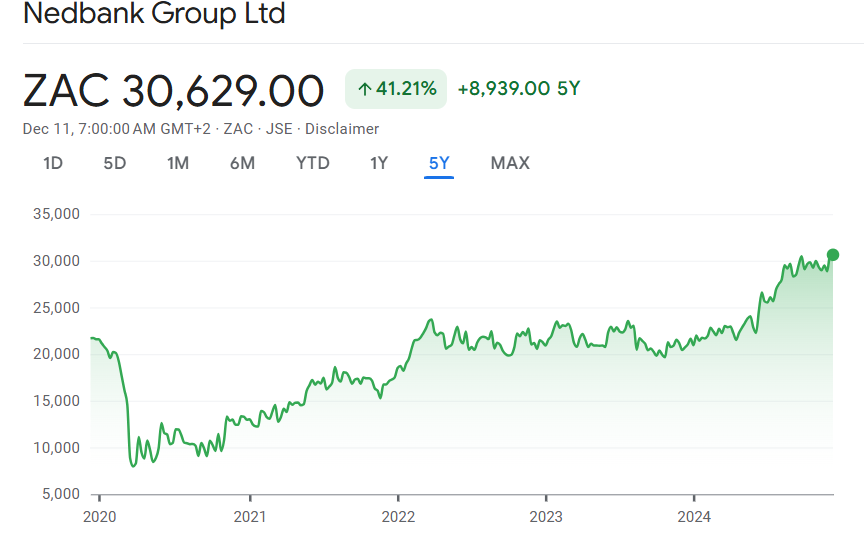
Despite the decreasing interest rates and what this will likely mean for banking margins going forwards, the market has been celebrating renewed confidence in South Africa with an excellent rally in Nedbank. The share price is up 42% this year, finally breaking out of the channel it was stuck in for a long time:
A pre-close update now gives us an updated view of the underlying business performance for the ten months to October.
Household credit growth was just 3.2%, which Nedbank reckons is the bottom of the cycle as interest rates have now started to ease and demand for credit should pick up. Corporate credit growth was up 5.6%, with hopes for this to increase in 2025 as business confidence improves.
Headline earnings growth is above mid-single digits, driven by lower impairments and strong growth in non-interest revenue (NIR), with the net interest income (NII) growth as a drag. Although they expect an improvement in NII in 2025, they will need decent growth in the book to offset the lower margins that are the inevitable outcome of decreasing interest rates.
The credit loss ratio is down year-on-year and is now within the top half of the approved through-the-cycle range of 60 to 100 basis points.
The cost-to-income ratio has unfortunately increased, so operating margins went the wrong way. This is why HEPS growth will only be mid-to-upper single digits. Still, that means growth ahead of inflation and that’s a decent outcome! An improvement in return on equity vs. last year is also good news for the share price.
Renergen released a short story on SENS, not just an announcement (JSE: REN)
And it all deals with the “implied threat to mineral rights”
If you’ve been following Renergen, you’ll know that they are currently having a large fight with a solar company that is busy developing a project on land where Renergen has a petroleum production right. There are a bunch of technical arguments here, with the solar company even appealing Renergen’s right to helium! Renergen’s argument is that helium cannot be separated from petroleum underground prior to extraction, so that is a moot argument as they have the petroleum right.
The timing of this is extremely inconvenient for Renergen, which I’m sure is no accident in terms of the solar company’s strategy. Renergen is looking to raise capital in the US and any question marks around the fundamental legal rights of the business make that very difficult.
Renergen has released a very long SENS announcement setting out the alleged behaviour of the solar group and the lack of meaningful engagement, along with the impact for the broader mining industry if construction is condoned by the DMRE without consent from existing mineral and petroleum right holders. Renergen is looking for an ability to co-exist with the solar group, provided their access to the known gas-bearing fault lines is protected.
It certainly doesn’t sound like an outrageous expectation from Renergen. With the share price down 48% this year, they really can’t afford any nonsense around their legal rights.
Sabvest takes broader exposure in moulded plastic products (JSE: SBP)
This is an example of how broad the portfolio is
Sabvest Capital is one of the more interesting investment holding companies on the JSE, with a broad portfolio of unlisted assets that investors cannot otherwise gain access to. This is how investment holding companies should work, as there’s really no point in a listed company having large stakes in other listed companies.
The latest news in the portfolio is that Sabvest is swapping its 47.5% holding in a company called Flexo line Products for a 23.75% stake in Amicus Investments. Flexo is the largest manufacturer of high quality injection moulded plastic products for the food industry. Amicus is a holding company for business operating in this space, so they are piecing together complementary businesses here in the hope of creating value.
It’s far too small a deal in the Sabvest context to require detailed disclosure, so we have no sense of numbers here.
South32 is being impacted by civil unrest in Mozambique (JSE: S32)
Production guidance for Mozal Aluminium has been withdrawn
South32 has released an announcement based on escalating civil unrest in Mozambique. The issue is road blockages, which are making it difficult to transport raw materials to Mozal Aluminium.
Given the uncertainty around the issue, the group has withdrawn guidance for Mozal Aluminium. There have thankfully been no security incidents at the facility thus far, so this is purely a logistics problem at the moment.
A far more bullish narrative at Thungela around production (JSE: TGA)
They even have nice things to say about Transnet!
If this Thungela update is anything to go by, then finding a lump of coal under the Christmas tree might not be so bad this year – especially if it takes the form of a share in Thungela! In a pre-close update, they note that full-year export saleable production is expected to exceed guidance in both South Africa and Australia. That’s a big deal!
To add to the cheer, they expect the FOB cost per export tonne to be below the guided range, thanks to higher production and cost efficiencies.
Perhaps the best news of all in this update is that things are getting better at Transnet Freight Rail, admittedly thanks to a lot of support from the coal industry that depends on this infrastructure. On an annualised industry basis, performance has improved from 47Mt in the first half of the year to around 56Mt at the moment.
The production side of the update is clearly positive. As for pricing, although there are factors supporting the coal price, the direction of travel in the past year has been downwards. For example, the Richards Bay Benchmark is down from $121 per tonne to $105.21 per tonne. The Newcastle Benchmark has dropped from $172.79 per tonne to $135.59 per tonne.
The benchmark price isn’t the same as the price that Thungela gets. The big swing there is on the Newcastle Benchmark, where they got 92% of the benchmark price this year vs. an 11% premium last year thanks to fixed price contracts that were part of the acquisition. The current discount is being driven by disappointing demand in Asian markets, so Chinese stimulus would help here.
Another important metric is capital expenditure. Total capital expenditure in South Africa for the year is expected to be R2.7 billion, of which R1 billion is maintenance capex and R1.7 billion in expansionary capex. Both numbers are within range. In the Australian business, maintenance capex of R550 million came in slightly below guidance.
With expected net cash of between R8 billion and R8.5 billion by the end of December and this positive outlook, things are on track for the dividend policy of distributing at least 30% of adjusted operating free cash flow to shareholders.
Nibbles:
Director dealings:
Ready to feel poor? After exercising options in the stock, a director of Naspers (JSE: NPN) sold shares worth R187 million!
The Chief Customer Officer of Powerfleet (JSE: PWR) sold shares worth a meaty $1.84 million. This works out to over 80% of the executive’s total position in the stock, so this is a major sale.
The CEO of Lewis (JSE: LEW) sold shares worth around R6.4 million. Given the focus on buybacks over the years, seeing the top executive selling into the market is an important signal.
Two directors of DRA Global (JSE: DRA) have bought shares worth roughly A$180k in total. This an Australian company, hence the reference to Australian dollars.
The outgoing CFO of AfroCentric (JSE: ACT) has sold shares worth R660k.
A director of MTN (JSE: MTN) has sold shares worth R632k.
Astoria Investments (JSE: ARA) has renewed the cautionary announcement regarding the potential sale of the 49% stake in ISA Carstens. An indicative non-binding offer has been received and negotiations are ongoing.
The scheme of arrangement for the deal that will see Capital & Regional (JSE: CRP) merge with NewRiver REIT has become effective. Capital & Regional will now delist and local investors in Growthpoint (JSE: GRT) will have indirect exposure to the merged portfolio.
Marshall Monteagle (JSE: MMP) has very little liquidity, so it only gets a mention down here. A trading statement for the six months to September reflects a jump in HEPS from 2.2 US cents to 6.2 US cents. They attribute this mainly to higher profits in the trading and property operations. They also note disposals of investments, although this would normally not fall into HEPS.
Super Group (JSE: SPG) announced that S&P Global Ratings has affirmed the company’s credit ratings. Given some of the recent changes at the company, ranging from disappointing performance in Europe through to the positive news of the deal in Australia, this is useful.
It never rains but pours in the platinum industry, with Wesizwe Platinum (JSE: WEZ) announcing a potential cybersecurity breach. Systems have been shut down and experts have been brought in to investigate the breach and recovery solutions. At this stage, there’s no indication of how severe the breach has been or whether there could be financial impacts (beyond the costs of expensive experts).
Sable Exploration and Mining (JSE: SXM) announced that the board has received a demand from holders of 10.74% of the company’s issued share capital to call a shareholders meeting. They are considering the demand and will update the market accordingly.
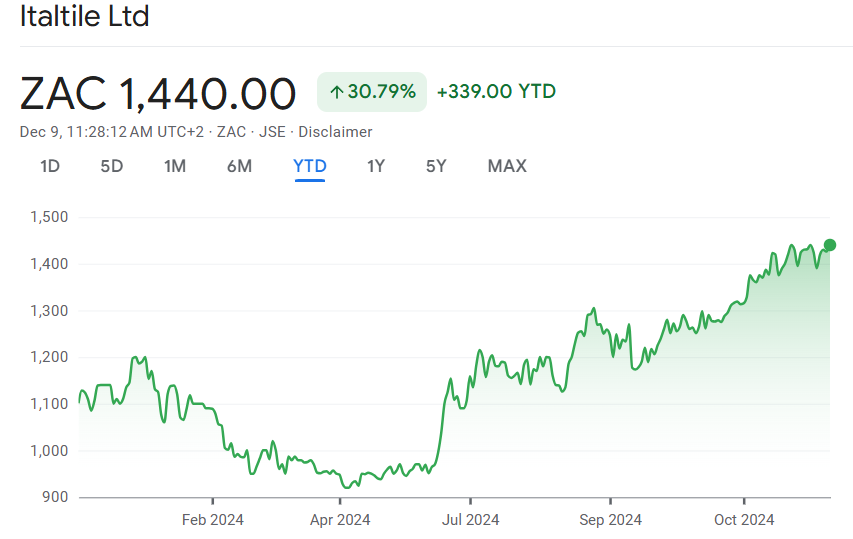
The Italtile share price momentum is beyond me (JSE: ITE)
The market is definitely applying rose-tinted glasses here
On paper, Italtile is well positioned to benefit from improved trading conditions and sentiment in South Africa. Decreasing interest rates will help with disposable income and the generally improved mood in the aftermath of the elections will help with the confidence needed to take that income and use it on home improvements. The disappearance of load shedding also plays a major role here. These are all the reasons why I’m sitting with a long Cashbuild position, as that business has many of the same underlying drivers.
The market has latched onto these concepts, giving the Italtile share price a massive boost since the election:
So, what’s the problem? Well, here’s the first clue: in the five director dealings announcements since the start of October, every single one has been an update of directors selling shares. They are selling into this strength that everyone else seems to be buying, which is a red flag for investors.
Is there a good reason for this selling? There absolutely is, with Italtile having told the market several times that the manufacturing side of the business is facing a substantial problem of over-capacity in the local industry. This is exactly why I hold Cashbuild instead of Italtile, as Cashbuild doesn’t have a manufacturing business.
In a voluntary sales update covering 1 July 2024 to 30 November 2024, Italtile has noted system-wide retail turnover growth of 2.2%. That’s not exactly exciting, but at least it’s green. The real benefits of lower interest rates and the two-pot system will take time to filter through to consumers.
As for the manufacturing business, revenue fell by 1.6%. This comes after a decline of 5.9% in the base period. You can be sure that costs aren’t decreasing, so you can imagine what this means for margins. They are talking about “predatory pricing” in the market, which isn’t good.
Results for the six months to December will be published by March. I really wouldn’t be surprised to see more director selling before then.
Nictus has had a year to remember (JSE: NCS)
Profits are nearly 4x higher than last year!
With a market cap of around R70 million, Nictus is really tiny by listed company standards. The market cap used to be even smaller if you can believe it, with the share price up strongly this year. The starting date for the share price return makes a huge difference which is why I didn’t include a percentage. This is an illiquid stock that can very easily double and then halve again over just a few days!
Illiquidity aside, the trajectory has been upwards. The share price is R1.40 at time of writing and it traded all the way down at 50 cents for most of January this year. Those who somehow navigated the bid-offer spread made solid gains.
These gains have been supported by a huge jump in HEPS for the six months to September from 6.94 cents in the comparable period to 26.51 cents in this period. The cause of this jump was a R14.5 million increase in investment income in the insurance business. Considering that profit before tax for the period came in at R20.2 million vs. R5.1 million in the prior year, you can see that the rest of the business was flat.
Sibanye-Stillwater finds a developer for the Beisa uranium project (JSE: SSW)
They retain exposure through royaltiesand an indirect shareholding
Sibanye-Stillwater is fighting the good fight against a PGM market that continues to create many sleepless nights for those involved. The company also has frequent examples of bad luck, which certainly don’t help. It therefore makes sense that they are entering into a deal that will see Neo Energy Metals acquire the Beatrix 4 shaft and therefore the Beisa uranium project. This puts the development risk onto Neo Energy’s balance sheet, allowing Sibanye to focus on the rest of its business.
Beatrix 4 was placed on care and maintenance in 2023 based on the declining gold reserves and pressure on uranium prices. With uranium prices having moved higher and enjoying a positive outlook, Neo Energy is swooping in to pay Sibanye R500 million for the shaft. This will be paid 50% in cash and 50% in newly issued shares, giving Sibanye a 40% stake in Neo Energy and thus significant indirect exposure to Beatrix 4.
Sibanye will also be paid royalties based on the spot uranium price, with a maximum of $5.00/lb. For context, the current price is $77/lb and it peaked in 2024 at $106/lb.
It sounds like a great deal for Sibanye then, as the group can enjoy long-term exposure to the asset without having to fund either the development or the rehabilitation and environmental liabilities of Beatrix 4. The parties just need to jump through a few regulatory hoops to get the deal across the line.
Brace yourself for the Transaction Capital results, when they eventually come (JSE: TCP)
They have been delayed due to changes to the disclosure notes related to SA Taxi
Transaction Capital is on the verge of releasing another horrible set of numbers. To give you some idea, the “core loss” – and this is the most favourable view of things after adjusting for discontinued operations and other distortions – will be between R82 million and R102 million for the year to September 2024. The headline loss without any adjustments and including total operations is between R2.18 billion and R2.36 billion!
With Nutun as the main business going forward, the market is going to place a lot of attention on those numbers when they come out. The financials were actually due for release already, but have been delayed due to disclosure changes in the notes for SA Taxi.
Every year in December, there’s a set of numbers somewhere on the market that are very ugly. Will Transaction Capital be the coal under the Christmas tree this year? It seems very possible.
Nibbles:
Director dealings:
The huge trades by Discovery (JSE: DSY) directors related to their derivative structures continue, with Adrian Gore selling shares worth R105 million and Barry Swartzberg selling shares worth around R195 million. In both cases, these are forced sales as part of the structures rather than sales by choice.
A prescribed officer of Gold Fields (JSE: GFI) acquired shares worth R2.1 million. Notably, this is towards the company’s minimum shareholding requirement, so it’s not as bullish a signal as would normally be the case.
Vodacom (JSE: VOD) and Remgro (JSE: REM) are keeping their options open just in case something major comes up in the Maziv fibre deal. They are therefore extending the longstop date by just a few weeks at a time, while they navigate the process of trying to get the regulators across the line. The latest extension is to 15 January 2025.
The Datatec (JSE: DTC) scrip dividend alternative was a success for the company, although I’m sure the extent of management shareholding in the group played a role here. The cash dividend came to R58.6 million and the company retained R116 million in cash by issuing shares in lieu of a dividend to shareholders who elected that alternative.
Oasis Crescent Property Fund (JSE: OAS) announced that holders of 41.1% of units elected to reinvest their distribution and the remaining 58.9% chose to receive cash distribution. I’m not sure if I’m missing a tax trick here, but considering the reinvestment price is the NAV of the units rather than the share price (and the NAV is a lot higher), I’m not sure why people would choose to reinvest.
Never heard of Assura plc (JSE: AHR)? Don’t worry, me neither! It popped up on SENS with an announcement of directors buying shares under a matching shares plan (a common incentivisation mechanism in the UK), forcing me to go find out how I somehow missed this company. As it turns out, this is a UK REIT that listed very quietly on the JSE on 21 November as part of a fast-track secondary listing process. It’s a large company, although local liquidity is close to zero.
Sable Exploration and Mining (JSE: SXM) planned to transfer certain subsidiaries to James Allan, the previous CEO. This will no longer proceed and the subsidiaries will be deregistered instead.
Sygnia Limited (JSE: SYG), AYO Technology (JSE: AYO) and Marshall Monteagle (JSE: MMP) are transferring their listings to the general segment of the JSE, as many small- and mid-cap companies have now done.
We use cookies on our website to give you the most relevant experience by remembering your preferences and repeat visits. By clicking “Accept All”, you consent to the use of ALL the cookies. However, you may visit "Cookie Settings" to provide a controlled consent.
This website uses cookies to improve your experience while you navigate through the website. Out of these, the cookies that are categorized as necessary are stored on your browser as they are essential for the working of basic functionalities of the website. We also use third-party cookies that help us analyze and understand how you use this website. These cookies will be stored in your browser only with your consent. You also have the option to opt-out of these cookies. But opting out of some of these cookies may affect your browsing experience.
Necessary cookies are absolutely essential for the website to function properly. These cookies ensure basic functionalities and security features of the website, anonymously.
Cookie
Duration
Description
cookielawinfo-checkbox-analytics
11 months
This cookie is set by GDPR Cookie Consent plugin. The cookie is used to store the user consent for the cookies in the category "Analytics".
cookielawinfo-checkbox-functional
11 months
The cookie is set by GDPR cookie consent to record the user consent for the cookies in the category "Functional".
cookielawinfo-checkbox-necessary
11 months
This cookie is set by GDPR Cookie Consent plugin. The cookies is used to store the user consent for the cookies in the category "Necessary".
cookielawinfo-checkbox-others
11 months
This cookie is set by GDPR Cookie Consent plugin. The cookie is used to store the user consent for the cookies in the category "Other.
cookielawinfo-checkbox-performance
11 months
This cookie is set by GDPR Cookie Consent plugin. The cookie is used to store the user consent for the cookies in the category "Performance".
viewed_cookie_policy
11 months
The cookie is set by the GDPR Cookie Consent plugin and is used to store whether or not user has consented to the use of cookies. It does not store any personal data.
Functional cookies help to perform certain functionalities like sharing the content of the website on social media platforms, collect feedbacks, and other third-party features.
Performance cookies are used to understand and analyze the key performance indexes of the website which helps in delivering a better user experience for the visitors.
Analytical cookies are used to understand how visitors interact with the website. These cookies help provide information on metrics the number of visitors, bounce rate, traffic source, etc.
Advertisement cookies are used to provide visitors with relevant ads and marketing campaigns. These cookies track visitors across websites and collect information to provide customized ads.